Environmental Benefits of Natural Pozzolan
Building Tomorrow's Infrastructure with Yesterday's Volcanic Wisdom
The Concrete Carbon Crisis
Environmental Minerals exists to tackle one of the hardest climate challenges on the planet: the carbon footprint of concrete. Concrete is the world's most widely used building material—second only to water in consumption—and cement production alone is responsible for about 8% of global CO₂ emissions, more than the entire aviation sector. By supplying high-performance natural pozzolan that replaces a significant share of high-carbon clinker, we help our customers pour more durable, longer-lasting concrete with substantially lower embodied CO₂. Our goal is simple and measurable: turn every ton of Environmental Minerals pozzolan into a permanent reduction in cement demand and a real, quantified cut in emissions, while supporting resilient infrastructure and a healthier environment.
Conclusion: Environmental Minerals Natural Pozzolan is the best choice for reducing concrete C02 emmission and creating sustaintainable structures. Save the Planet.
A Global Emergency Hiding in Plain Sight
Concrete is essential to modern life—the foundation of every road, bridge, building, and dam we depend on. But its cement binder is one of the planet's biggest single industrial sources of CO₂:
Cement production accounts for roughly 8% of global CO₂ emissions, more than the entire aviation industry. If the cement industry were a country, it would rank as the third-largest emitter in the world, behind only China and the United States.
Concrete is the most widely used building material in the world and the second most consumed resource on Earth after water, so any inefficiency in its production or performance is amplified on a massive, global scale.
Typical Portland cement production emits about 0.8–0.9 tons of CO₂ per ton of cement, once you add up the fuel burned and the chemical CO₂ released during limestone calcination.
Every bridge, road, and building we pour today locks in decades of embodied carbon—and when that concrete fails prematurely due to poor durability, we emit even more CO₂ to demolish and replace it.
Why Clinker Is the Problem
The Hidden Carbon Bomb in Every Concrete Mix
The core of the concrete carbon problem is clinker, the intermediate product that becomes Portland cement:
Clinker makes up less than 15% of the total mass of concrete, but accounts for over 90% of concrete's carbon footprint.
Producing clinker requires heating limestone and clay to about 1,450°C (2,640°F), which emits CO₂ from two sources:
Fuel combustion (coal, natural gas, or oil) → ~40% of emissions
Chemical decomposition of limestone (CaCO₃ → CaO + CO₂) → ~60% of emissions
Because the limestone-chemistry emissions are inherent to making clinker, even a fully renewable-energy kiln would only cut about one-third of clinker's carbon footprint. The only way to make a major dent is to use less clinker per cubic yard of concrete
A precise statement of the problem:
"The production of clinker—the reactive core of Portland cement—accounts for the vast majority of CO₂ emissions associated with cement manufacturing."
This is why every percentage point of clinker replaced with a low-carbon supplementary cementitious material (SCM) like natural pozzolan has an outsized climate benefit.
How Natural Pozzolan Changes the Equation
Cutting Carbon by Replacing Clinker
Natural pozzolan reduces CO₂ not by tweaking the kiln, but by replacing part of the clinker in concrete with a reactive volcanic mineral that is quarried and ground rather than calcined at extreme temperatures:
Emissions Comparison: Natural Pozzolan vs Fly Ash vs Portland Cement
Ordinary Portland cement (OPC): ~800–900 kg CO₂ per ton
Fly ash: Variable, but typically ~50–150 kg CO₂ per ton (tied to coal combustion; supply declining)
Natural pozzolan: ~16.5 kg CO₂ per ton (quarrying and grinding only), plus ~10.9 kg CO₂/ton for transport
Life-cycle assessments show that raw natural pozzolans can deliver up to ~95% lower greenhouse gas emissions per ton than Portland cement.
Real-World CO₂ Reductions by Replacement Level
Design studies and case projects using natural pozzolan as a cement replacement demonstrate quantified CO₂ savings:
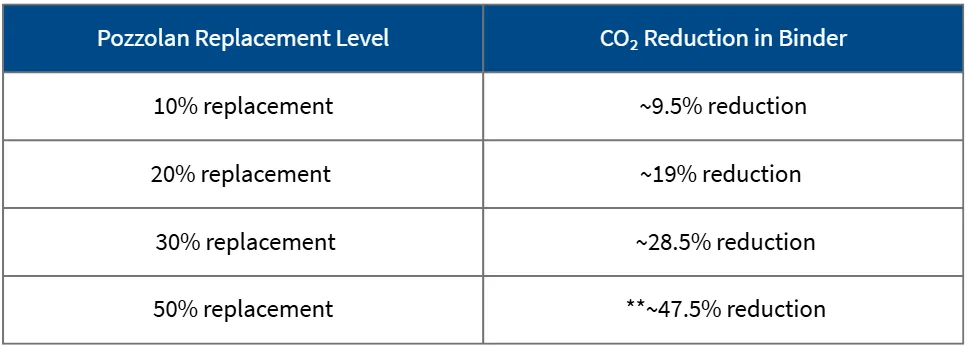
In practice, 30–50% natural pozzolan replacement can cut cement-related CO₂ emissions by 30–50% while maintaining or improving strength and durability.
Performance Without Compromise
Recent research on high-volume natural volcanic ash (VA) concretes shows:
30% VA replacement achieved comparable compressive strength to OPC control concrete while showing much better resistance to chloride ingress (critical for bridges, marine structures, and DOT work).
Life-cycle assessment identified the 30% VA mix as having significantly lower CO₂ emissions than conventional concrete, at similar overall cost, making it the most sustainable option when both emissions and economics were considered.
Research on calcined natural pozzolans shows mixes with up to 40% replacement can match or exceed ordinary Portland cement strength (up to +35% at 28 days) while materially reducing the binder's carbon footprint.
Bottom line: By substituting a significant fraction of high-carbon clinker in concrete, Environmental Minerals' natural pozzolan offers a clear pathway to double-digit percentage reductions in embodied CO₂ per cubic yard of concrete, without sacrificing performance.
Potential for Carbon Credits
Turning Every Yard of Concrete into a Climate Asset
Natural pozzolan doesn't just "emit less"; it enables measurable, project-level CO₂ reductions that can potentially qualify for carbon credits under existing and emerging methodologies:
Many voluntary carbon programs recognize material substitution and low-carbon concrete as eligible project types when the reduction versus a baseline mix is quantifiable and independently verified.
Because cement emissions are relatively well characterized (≈0.8–0.9 t CO₂ per ton of cement), replacing a portion of that cement with a much lower-carbon natural pozzolan creates a clear, auditable delta in emissions per cubic meter of concrete.
Positioning for carbon markets:
"By reducing high-emission clinker content in concrete mixes, Environmental Minerals' natural pozzolan can help owners and developers document verifiable embodied-carbon reductions, potentially supporting participation in low-carbon concrete procurement programs and future carbon credit frameworks focused on material substitution and life-cycle emissions."
The True Cost of Concrete: Material Price vs Lifecycle Economics
Why Cheap Concrete Is Actually Expensive
The real economic story isn't in the price per cubic yard—it's in the life-cycle cost of failure:
Up-Front Material Costs
Natural pozzolan is typically cheaper per ton than Portland cement in regions with good deposits, and when used as a partial cement replacement, total binder cost per cubic yard usually goes down or stays flat.
Fly ash can look inexpensive where it's local, but as coal plants retire:
Transport distances and beneficiation costs rise
Supply becomes variable, forcing conservative designs and higher contingencies
Heavy metal and environmental legacy concerns grow
The Hidden Costs of Concrete Failure
When concrete isn't sufficiently durable (e.g., high permeability, poor ASR control, weak sulfate resistance), owners pay far more than they saved on materials:
Direct repair costs:
Traffic control and lane closures (lost productivity, detours)
Demolition of damaged concrete
Surface preparation, rebar repair or replacement
New concrete placement and curing time
Overlays, coatings, repainting, cleanup, and inspections
Indirect costs:
Lost revenue from facility shutdowns (hotels, condos, industrial plants)
Safety risks and liability exposure
Reputational damage and loss of asset value
In extreme cases: catastrophic structural failure and loss of life
Studies modeling bridge-deck service life show that once corrosion cracks appear, propagation to serious damage can take only ~16 years, triggering costly repairs. Those indirect costs far exceed the price difference between a standard mix and a slightly more expensive, pozzolan-rich mix poured on day one.
How Porous Concrete Leads to Rusty Rebar—and Structural Failure
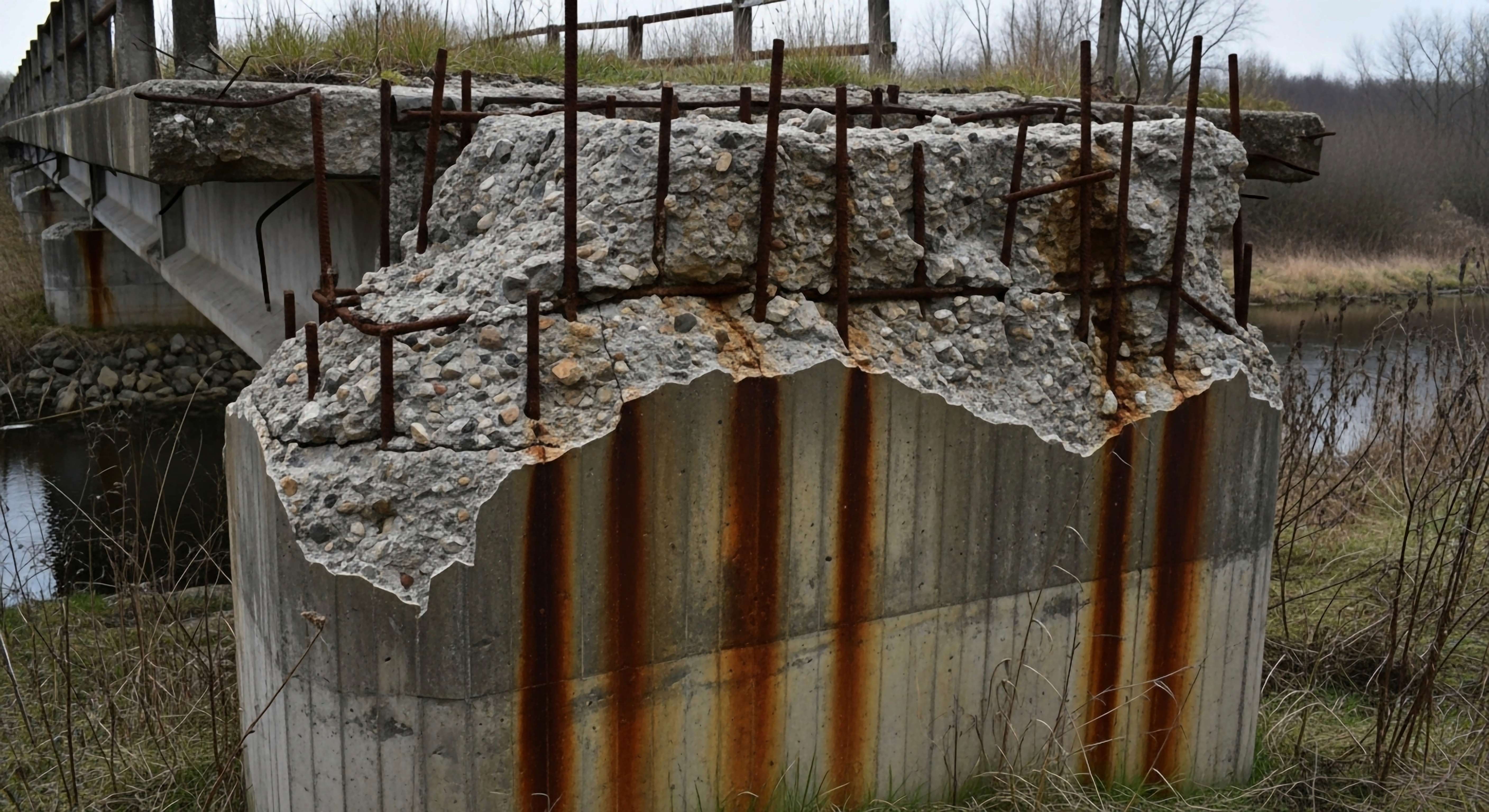
The Corrosion Cascade
Concrete is supposed to protect steel reinforcing bars (rebar) by creating a high-pH alkaline environment that forms a passive oxide layer on the steel, preventing corrosion. But when concrete is porous and permeable, this protective system breaks down:
Step 1: Water and Chlorides Penetrate
Rain, groundwater, de-icing salts, or salt spray penetrate through pores and microcracks in the concrete
Chloride ions from these sources travel through the concrete matrix toward the embedded steel
Step 2: Corrosion Begins
Chlorides reach the rebar surface and break down the passive oxide layer
Steel begins to rust (oxidize), expanding in volume by 2–6 times as it converts from metallic iron to iron oxide (rust)
Step 3: Concrete Cracks and Spalls
Expanding rust exerts tremendous pressure on surrounding concrete
Concrete cracks radially from the rebar
Pieces of concrete break away (spalling), exposing more steel to moisture and accelerating corrosion
Step 4: Structural Compromise
Loss of rebar cross-section reduces load-bearing capacity
Loss of bond between steel and concrete compromises structural integrity
In severe cases, catastrophic failure can occur
How Natural Pozzolan Breaks the Cycle:
Natural pozzolan dramatically reduces concrete permeability through its pozzolanic reaction, which:
Fills capillary pores with calcium-silicate-hydrate (C-S-H) gel, the primary binding phase in concrete
Reduces pore connectivity, making it much harder for water and chlorides to migrate through the concrete
Increases electrical resistivity, slowing the electrochemical corrosion process
Extends the time to corrosion initiation by years or decades, giving structures much longer service lives
Research shows that concrete with 30% natural pozzolan replacement can achieve:
40–60% decrease in water penetration
Significantly reduced chloride ingress compared to OPC-only concrete
Enhanced resistance to sulfate attack, ASR, and freeze-thaw cycles
By making concrete less porous, natural pozzolan protects the steel inside—which protects the structure for decades longer.
Real-World Stories: The Hidden Costs of Concrete Failure
Story 1: The Navy Pier That Rusted from Within
The Problem:
A coastal naval pier was built with a conventional OPC concrete mix, lightly modified but without robust SCM content. Within 10–15 years:
Salt spray and tidal wetting drove chlorides through the concrete cover, corroding rebar and causing spalling
Cracking appeared on the soffit and beams; chunks of concrete began falling
Safety inspections triggered emergency closures and mission disruptions
The Costs:
Direct expenses:
Mobilization of specialized marine contractors, barges, and cranes: $500K–$1M+
Demolition of deteriorated beams and deck sections: $750K–$2M
Complex rebar replacement, cathodic protection installation, and high-performance repair mortars: $2M–$5M
Engineering, inspection, and project management: $300K–$500K
Indirect costs:
Lost operational time for ships and helicopters using the pier: millions in mission delays
Rescheduled deployments and training exercises
Reputational impact and loss of operational readiness
Total repair cost for a single pier structure: $4M–$10M+
The Alternative:
Specifying a natural pozzolan concrete with 30% SCM replacement would have:
Cost an additional ~$50–$100 per cubic yard in materials (roughly $50K–$200K total for the original pour)
Delivered lower permeability and enhanced chloride resistance
Extended service life by decades before significant chloride penetration reached rebar-corrosion thresholds
Avoided the entire $4M–$10M+ repair cycle
The incremental cost of natural pozzolan in the original mix is tiny relative to the multi-million-dollar repair cycles in a marine environment.
Story 2: The Bridge Deck That Never Stops Needing Repairs
The Problem:
State DOT bridge decks in cold climates face a brutal combination: de-icing salts, thin cover, freeze-thaw cycles, and OPC-rich mixes. Many decks need major rehabilitation well before their nominal design life.
Typical life-cycle pattern:
Year 10–15: First cracks from corrosion show up; patching and sealing begins ($50K–$200K)
Year 20–25: Large areas delaminate; traffic lanes closed for deck milling, partial replacement, and overlays ($500K–$2M)
Year 35–40: Full deck replacement required; complete closure, demolition, and reconstruction ($3M–$8M+)
Each major rehab event includes:
Traffic management, detours, and lane closures (user delay costs can exceed construction costs)
Mobilization of contractors and equipment
Removal and disposal of deteriorated concrete
Rebar inspection, cleaning, and replacement
New concrete placement and extended curing time
Surface treatments, joint sealing, and waterproofing
Inspection, testing, and acceptance
Total lifecycle cost over 75 years: $5M–$15M+ in repairs alone, not counting user delay costs
The Alternative:
Switching to a low-permeability natural pozzolan mix (25–35% replacement):
Adds ~$75–$150 per cubic yard to initial construction cost (roughly $150K–$400K total for a typical bridge deck)
Slows chloride ingress and delays time to corrosion initiation and cracking
Can extend time to first major intervention by a decade or more
Effectively cuts the number of expensive rehab cycles over a 75-year design life from 3–4 to 1–2
Lifecycle savings: $3M–$10M+ over the bridge's service life, plus reduced traffic disruption and user delay costs
That's where natural pozzolan's value is clearest: not just cheaper per yard, but fewer shutdowns and fewer six-figure rehab events.
Story 3: The Condo That Collapsed—Surfside as a Cautionary Tale
The Tragedy:
On June 24, 2021, Champlain Towers South, a 12-story beachfront condominium in Surfside, Florida, partially collapsed, killing 98 people. It remains one of the deadliest structural failures in U.S. history.
The Root Cause: Corrosion and Concrete Deterioration
A detailed corrosion-engineering assessment concluded:
Salt-laden moisture from the pool deck and the marine environment penetrated cracked, poorly drained concrete
Reinforcing steel corroded over decades, spalling concrete and weakening key structural elements (especially column-slab connections)
Repairs were delayed, incomplete, or inadequate, allowing deterioration to continue unchecked
The pool deck was identified as likely the first structural element to fail, triggering progressive collapse of the tower
The Costs—Human and Economic:
Human cost:
98 lives lost
Families destroyed, survivors traumatized
A permanent scar on the community
Economic cost:
Full demolition and debris removal of a major oceanfront condo tower: $10M–$20M+
Massive insurance and liability payouts: $997M settlement (one of the largest wrongful death settlements in U.S. history)
Loss of use and value of neighboring structures during investigations and litigation
Permanent hit to confidence in similar coastal buildings; widespread inspections and retrofits required statewide
The Lesson:
No material alone can prevent every failure, but high-durability, low-permeability concrete with robust SCM content (including natural pozzolan) is one of the clearest ways to slow the corrosion clock in coastal buildings and exposed podium decks.
Reducing cracking, permeability, and ASR susceptibility is not just academic—it directly reduces the risk envelope for owners, residents, and the public.
For hotels, condos, and industrial buildings, even non-catastrophic failures are expensive:
Typical repair scenario costs:
1. Structural assessment and engineering: $50K–$200K
2. Scaffolding, shoring, and safety measures: $100K–$500K
3. Facility shutdown (lost revenue):
Hotels: $10K–$50K per day in lost room revenue
Industrial plants: $50K–$500K+ per day in lost production
Condos: Displacement costs, loss of property value
4. Demolition of damaged concrete: $150K–$500K
5. Rebar cleaning, replacement, cathodic protection: $200K–$1M
6. New concrete placement and curing (weeks of downtime): $300K–$1M
7. Waterproofing, repainting, finishing: $100K–$300K
8. Cleanup, debris removal, final inspection: $50K–$150K
9. Legal, insurance, and contingency: 10–20% of total
Total repair cost for a significant corrosion failure in a 10–20 story building: $1M–$5M+
Total cost of preventative measures with natural pozzolan in the original mix: $100K–$500K (incremental cost over standard mix)
All of that is avoided or delayed by spending marginally more on a robust mix design up front, using natural pozzolan to make the concrete itself last longer.


