Technical Data – Natural Pozzolan for Concrete
Complete Specification & Performance Guide for Engineers, Designers, and Producers
Highest Performance Natural Pozzolan
Environmental Minerals' Class N natural pozzolan is engineered for spec‑driven designers who need a reliable, high‑performance supplementary cementitious material (SCM) that cleanly qualifies under ASTM C618. It not only meets the Class N thresholds—it gives you margin on every critical parameter that governs durability, compatibility, and mix performance.
This document provides complete technical specifications, performance data, and practical guidance for engineers, concrete producers, and project managers specifying or using natural pozzolan in structural and infrastructure concrete.
ASTM C618 Class N Compliance
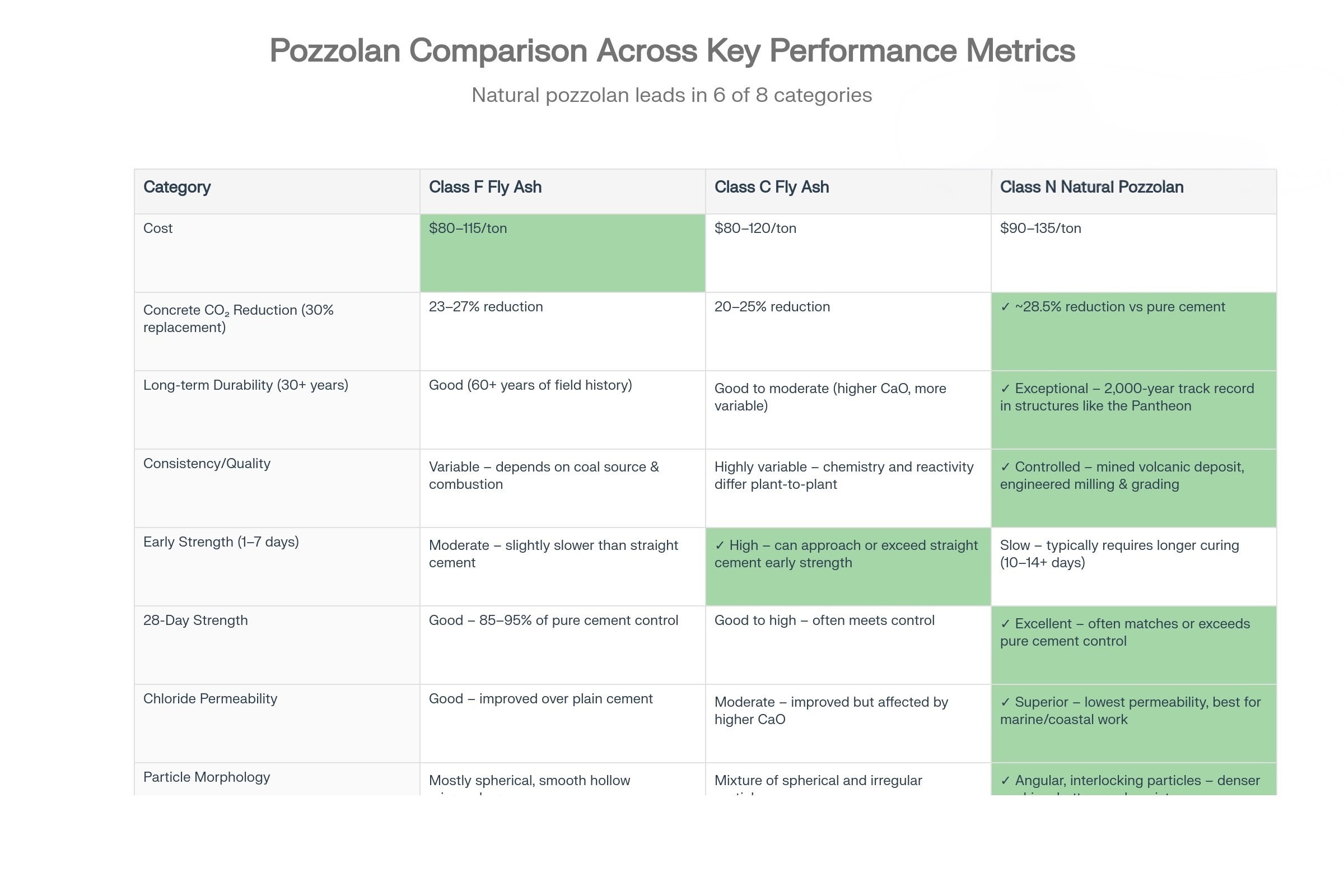
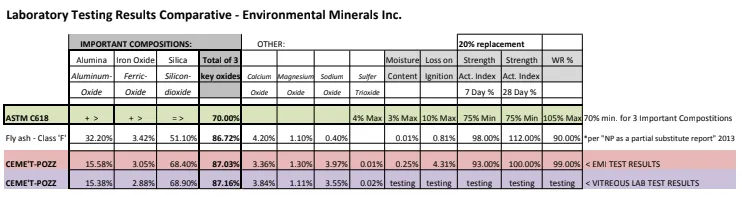
Environmental Minerals' natural pozzolan consistently exceeds ASTM C618 Class N specifications – the highest grade classification for supplementary cementitious materials used as cement additives in concrete production.
Understanding What These Numbers Mean for Your Project
1. Chemistry Where It Matters Most
Combined Reactive Oxides: SiO₂ + Al₂O₃ + Fe₂O₃ > 70%
The combined reactive oxides are comfortably above the 70% Class N minimum, ensuring strong pozzolanic reactivity and efficient consumption of portlandite (calcium hydroxide) during concrete curing and long‑term service.
What this means for your mix design:
- Supports denser calcium‑silicate‑hydrate (C‑S‑H) formation—the primary binding phase in concrete
- Reduces permeability and improves long‑term durability
- Enables improved strength development beyond 28 days (critical for infrastructure design lives of 75–100+ years)
- Provides enhanced resistance to aggressive environments (chlorides, sulfates, freeze–thaw)
Applications: Structural concrete, bridge decks, marine structures, high‑durability infrastructure
2. Tight Control of Deleterious Components
Sulfur Trioxide (SO₃) < 4%
SO₃ is held well below the 4% Class N limit, reducing risk of sulfate‑related expansion or compatibility issues with modern cements and admixtures.
What this means for your mix design:
- Minimizes risk of delayed ettringite formation (DEF) in mass concrete or steam‑cured elements
- Ensures compatibility with Type I/II and Type V cements and modern chemical admixtures
- Reduces potential for expansive reactions in service
- Supports stable long‑term volume stability
Moisture Content < 3%
Moisture content is controlled below 3%, which helps with handling, dosing accuracy, and stable workability from batch to batch.
What this means for production:
- Consistent batching and dosing accuracy (critical for ready‑mix and precast operations)
- Predictable water demand batch‑to‑batch
- Reduced risk of clumping or bridging in silos and bulk storage
- Stable workability and slump retention
Loss on Ignition (LOI) < 10%
Loss on ignition is kept well under the 10% cap, indicating low levels of unburnt carbon or organics that could otherwise interfere with air‑entrainment or admixture efficiency.
What this means for your mix design:
- Reliable air‑entrainment performance in freeze–thaw environments (critical for pavements and northern climates)
- Consistent admixture response and dosage rates
- Minimal interference with water reducers, superplasticizers, and retarders
- Clean, consistent color in architectural concrete
Applications: Air‑entrained concrete, architectural finishes, mass concrete, cold‑climate construction
3. Optimized Fineness for Reactivity and Workability
Fineness: Passes No. 325 Sieve (45 µm) – Typically ≈ 20% Retained
Fineness is better than the ASTM maximum retained on the No. 325 sieve, giving a particle size distribution that is reactive enough to drive pozzolanic reactions while still maintaining good workability and manageable water demand.
What this means for your mix design:
- Higher surface area for pozzolanic reaction (faster strength development and denser microstructure)
- Efficient cement replacement at 20–40% dosage levels
- Maintains workability without excessive water demand
- Does not require aggressive water reducer dosing to compensate for fineness
- Supports smooth pumping and placement
In practical mix design, that means you can substitute a significant portion of cement (30–50%) without chasing slump or overdosing water reducers.
Applications: High‑replacement mixes (30–50% cement replacement), pumped concrete, self‑consolidating concrete (SCC)
4. Proven Pozzolanic Activity at 7 and 28 Days
Strength Activity Index:
- 7 days: Exceeds 75% (typically ≈ 80%)
- 28 days: Exceeds 85% (typically ≈ 90%)
Strength activity indices at both 7 and 28 days exceed the 75% Class N requirement, with headroom to support performance‑based specifications and accelerated construction schedules.
What this means for your project:
- Meet early‑age strength targets for formwork removal, post‑tensioning, and traffic opening
- Support accelerated construction schedules without sacrificing long‑term performance
- Gain extended strength and durability benefits beyond 28 days (strength continues to develop for months to years)
- Enables higher cement replacement rates (30–50%) without sacrificing performance
- Supports both prescriptive (ASTM C618) and performance‑based DOT and agency specifications
The strong 28‑day index (≈ 90%) indicates that long‑term strength development will match or exceed conventional OPC mixes, even at high replacement levels.
Applications: Precast/prestressed concrete, fast‑track construction, performance‑based DOT specifications, high‑durability infrastructure
Environmental Minerals meets or exceeds all qualifications for ASTM C618 Natural Pozzolan
Chemical Composition for Optimal Concrete Performance
Environmental Minerals' pozzolan's unique volcanic origin provides optimal chemical composition for superior concrete performance when used as cement additive:
- Silicon Dioxide (SiO₂): Primary reactive component for concrete strength development. Reacts with portlandite to form additional C‑S‑H gel.
- Aluminum Oxide (Al₂O₃): Enhances concrete durability and chemical resistance. Contributes to formation of calcium‑aluminate‑hydrates.
- Iron Oxide (Fe₂O₃): Contributes to long‑term concrete strength gain and pozzolanic reactivity.
- Calcium Oxide (CaO): Low content prevents expansive reactions in concrete and reduces risk of delayed hydration issues.
- Alkali Content: Minimal levels eliminate alkali‑silica reaction (ASR) concerns in concrete, even with marginally reactive aggregates.
This balanced composition ensures robust performance across a wide range of mix designs, cement types, and exposure conditions.
Concrete Performance Validation
Third‑party testing by major concrete industry customers and independent laboratories confirms exceptional quality and consistency. Our cement additive material demonstrates:
- Enhanced Concrete Compressive Strength: 15–25% improvement over Portland cement‑only concrete at 28+ days
- Reduced Concrete Permeability: 40–60% decrease in water penetration (critical for durability in aggressive environments)
- Superior Concrete Durability: Resistance to sulfate attack, ASR, chloride ingress, and freeze–thaw cycles
- Consistent Concrete Quality: Homogeneous volcanic deposit ensures uniform concrete specifications batch‑to‑batch
Government and Industry Validation
Laboratory programs for the U.S. Army Corps of Engineers (USACE) and multiple state Departments of Transportation (DOTs) show that replacing 10–30% of Portland cement with properly characterized natural pozzolan can:
- Maintain or increase compressive strength at later ages (56+ days)
- Lower heat of hydration by 15–30% (critical for mass concrete in dams, foundations, and mat slabs)
- Significantly reduce ASR‑related expansion when tested per ASTM C1567 and ASTM C1293
Historical Performance Validation
The Pantheon's unreinforced concrete dome with its famous oculus demonstrates the ultimate proof of concept – nearly two millennia of structural perfection using pozzolanic cement additives. This 2,000‑year‑old structure remains the world's largest unreinforced concrete dome, proving that pozzolanic concrete can deliver exceptional durability and longevity.
Mix Design Guidance
Recommended Replacement Levels
Standard Structural Concrete:
- 20–30% cement replacement by mass
- Maintains early‑age strength while improving long‑term durability
- Suitable for most building and infrastructure applications
- Typical 28‑day strength: 4,000–6,000 psi
High‑Durability Applications:
- 30–40% cement replacement by mass
- Maximizes permeability reduction and chloride resistance
- Ideal for marine structures, bridge decks, parking structures, coastal buildings
- Extended service life in aggressive environments
Mass Concrete:
- 30–50% cement replacement by mass
- Reduces heat of hydration by 15–30%
- Minimizes thermal cracking risk in large pours (dams, foundations, mat slabs)
- Allows larger placements without excessive temperature rise
Typical Mix Adjustments
When replacing Portland cement with Environmental Minerals natural pozzolan at 20–40% levels:
Water demand: Typically neutral to slightly reduced due to optimized particle size distribution
Admixture dosing: May require minor adjustment (±10–15%) in water reducer or superplasticizer dosage
Set time: Slightly extended initial set (15–30 minutes) at high replacement levels; no significant impact on final set
Strength development: Early strength (3–7 days) similar to OPC; 28+ day strength equal or higher
Color: Light tan to gray; consistent within each shipment; suitable for architectural applications
Note for ready‑mix producers: Trial batches recommended to optimize admixture dosing and confirm workability for specific mix designs and local materials.
Specification-Ready for Performance Concrete
Taken together, these values give structural engineers, materials engineers, and concrete producers a Class N pozzolan that is:
✅ Straightforward to qualify – Meets every ASTM C618 Class N chemical and physical requirement with margin
✅ Easy to justify in submittals – Clear compliance documentation and third‑party test data available
✅ Robust in real‑world production – Consistent quality from a homogeneous volcanic deposit
✅ Proven in demanding applications – Bridge decks, marine structures, mass concrete, high‑durability buildings
You can confidently deploy it in:
- Bridge decks and transportation infrastructure
- Marine structures and coastal construction
- Mass concrete (dams, foundations, mat slabs)
- High‑durability building elements
- Precast/prestressed concrete
- Parking structures and industrial floors
- Any application where ASTM C618 Class N compliance is required
Natural Pozzolan vs Fly Ash
For decades, coal fly ash has been the dominant supplementary cementitious material (SCM) used to enhance concrete performance and reduce cement content in concrete mixes. As coal‑fired power plants shut down, however, fly ash supplies are becoming increasingly unreliable, inconsistent, and geographically constrained. Concrete producers, DOTs, and infrastructure owners are now seeking long‑term, stable SCM solutions that deliver equal or better performance with lower environmental risk.
Performance Advantages of Natural Pozzolan
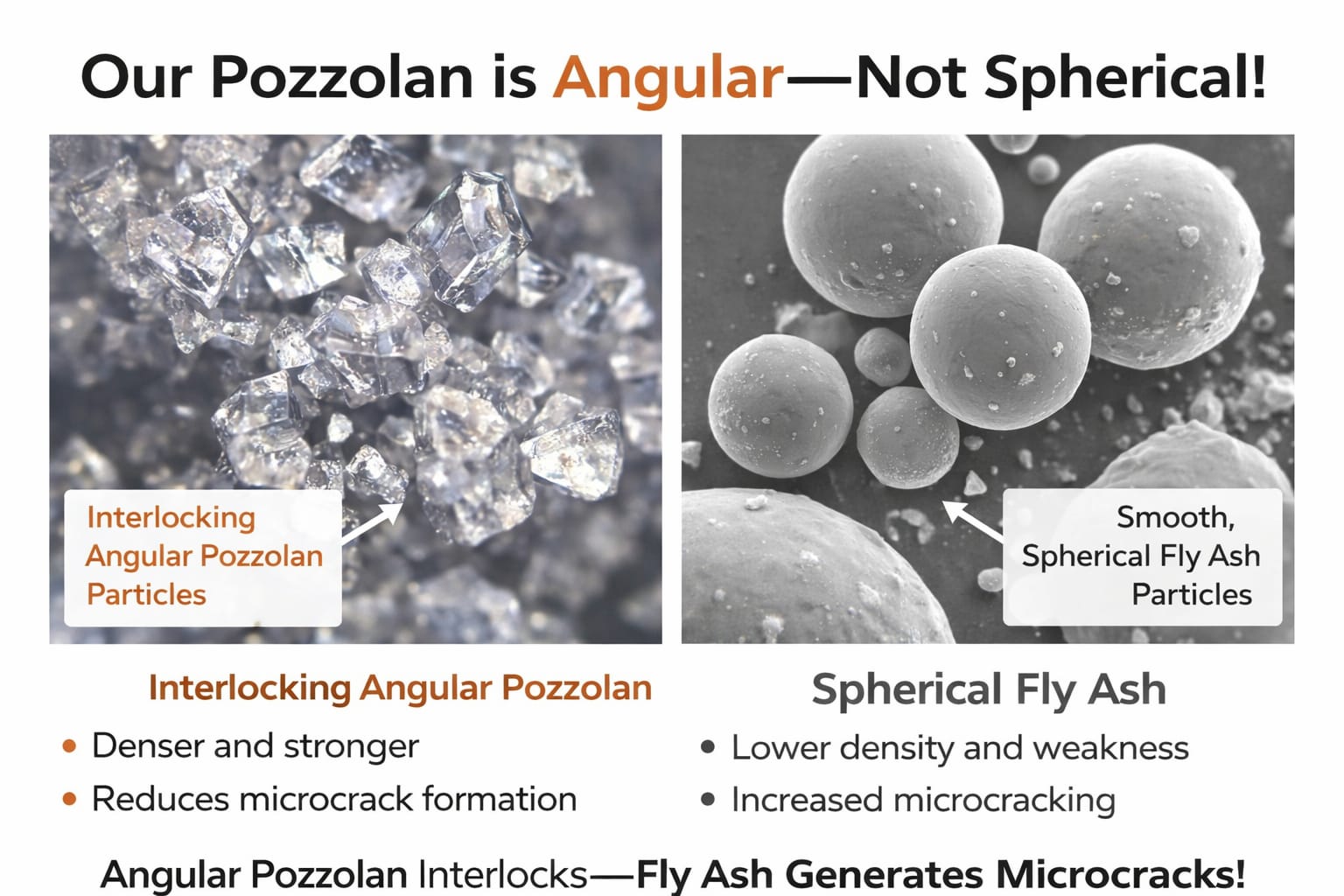
Properly processed natural pozzolan provides performance benefits that meet or exceed typical fly‑ash‑based concrete mixes:
- Consistent mineralogy and chemistry from homogeneous volcanic deposits, reducing batch‑to‑batch variability in concrete performance
- Improved long‑term strength development, with sustained strength gain beyond 28 days for durable structural and infrastructure applications
- Lower permeability and higher durability, helping protect reinforcing steel and extend service life in aggressive environments
- Enhanced resistance to sulfate attack, alkali‑silica reaction (ASR), and chloride ingress, making it ideal for transportation, marine, and water infrastructure
Natural pozzolan S1 met all ASTM C618 requirements for Class F/C fly ash, including fineness, strength activity index, autoclave expansion, and drying shrinkage, and was concluded to be a suitable substitute for fly ash in concrete.
Reference: ERDC‑CERL TR‑11‑46
Supply, Quality, and Risk Considerations
Relying on fly ash ties concrete production to the coal power industry, which is rapidly contracting under environmental and policy pressure. This leads to:
Fly ash challenges:
- Uncertain long‑term availability and regional shortages as coal plants retire
- Highly variable quality as remaining plants and ash handling systems age
- Growing logistics and transportation costs as sources move farther from end users
- Heavy metal and environmental legacy concerns in some jurisdictions
Natural pozzolan advantages:
Natural pozzolan, by contrast, is sourced from secure, permitted mineral deposits dedicated to construction materials, allowing:
- Long‑term reserve planning and predictable supply
- Tight quality control at the mine and processing facility
- SCM strategies that are independent of the coal power sector
- No heavy metal or coal‑combustion byproduct concerns
Environmental Minerals' Southern California deposit contains 250+ million tons of reserves—a 500+ year mine life at full production. With a 4,000‑acre site, supply is essentially limitless, significantly reducing the risk of supply shortages or price volatility over the long term.
Environmental and Regulatory Benefits
Both fly ash and natural pozzolan can reduce cement content and associated CO₂ emissions in concrete, but natural pozzolan offers additional environmental and regulatory advantages:
- No legacy concerns around heavy metals or coal‑combustion byproducts in infrastructure projects
- Clearer permitting pathways and acceptance for sustainable, low‑carbon concrete initiatives
- Strong alignment with modern climate, ESG, and green‑building requirements seeking natural, low‑impact SCMs
- Over 20% lower carbon footprint compared to man‑made alternatives like fly ash
Concrete mixes with natural pozzolan S produced about 15% less heat of hydration than equivalent mixes with fly ash, and about 30% less than straight Portland cement mixes, which is highly beneficial for massive placements such as dams and foundations.
Reference: ERDC‑CERL TR‑11‑46
Why Developers and Engineers Prefer Natural Pozzolan
Forward‑looking agencies, engineers, and infrastructure investors increasingly seek materials that support 75–100+ year design lives with reduced lifecycle cost. Natural pozzolan helps them:
- Design concrete mixes with extended durability and reduced maintenance intervals
- De‑risk long‑term projects from SCM supply disruptions (not dependent on coal power sector)
- Document clear, defensible sustainability benefits in line with emerging codes and procurement standards
- Meet performance‑based specifications without supply uncertainty
Additional Performance Benefits
Enhanced Durability Performance
Beyond meeting ASTM C618 chemical limits, Environmental Minerals' natural pozzolan delivers measurable durability improvements:
Permeability Reduction:
- 40–60% decrease in water penetration vs OPC‑only concrete
- Significantly reduced chloride ingress (critical for bridges and marine structures)
- Enhanced resistance to sulfate attack
- Denser microstructure and reduced capillary porosity
ASR Mitigation:
- Effective alkali‑silica reaction (ASR) control at 20–30% replacement levels
- Supports use of locally available aggregates that may be marginally reactive
- Reduces long‑term expansion risk in ASR‑prone environments
- Tested per ASTM C1567 and ASTM C1293 protocols
Freeze–Thaw Resistance:
- Compatible with air‑entrainment systems (does not interfere with air void formation)
- Does not interfere with air void system development or spacing factor
- Supports durable concrete in cold climates and de‑icing salt environments
- Critical for pavements, bridge decks, and northern infrastructure
Corrosion Protection:
- Denser pore structure extends time to corrosion initiation by years or decades
- Protects embedded reinforcing steel in aggressive chloride environments
- Reduces chloride diffusion rates by 40–60%
- Critical for extending service life of bridges, parking structures, and marine facilities
Quality Assurance and Supply Reliability
Deposit Characteristics
- Homogeneous volcanic deposit ensures consistent chemistry and mineralogy batch‑to‑batch
- Dedicated construction materials operation – not dependent on coal power industry like fly ash
Testing and Certification
- Third‑party laboratory testing by ALS Geochemistry Global and Resource Materials Testing Inc.
- Batch testing for every shipment to verify ASTM C618 compliance
- Geologic assessment by licensed professional geologist (Frederic C. Johnson, P.G.)
- Environmental compliance documentation from Stantec Environmental Services
Technical Reports Available
Detailed technical reports and test data available upon request:
- Geological Assessment – Frederic C. Johnson, P.G.
- Chemical Analysis – ALS Geochemistry Global
- Concrete Performance Testing – Resource Materials Testing Inc.
- Environmental Compliance – Stantec Environmental Services
For a more detailed analysis of the use of Pozzolan as an SCM, download Construction Engineering Lab Test from US Army Core of Engineers.
Technical Consultant
For technical inquiries, material samples, independent testing, or project specifications:
Jay Bergeron
Technical & Environmental Consultant


